
Blog
Whats The Working Principle Of Diesel Generator

The Diesel Generator Working Principle
Every standby installation, from a single-shift workshop to a continuous-process textile mill, rests on one proposition: fuel enters the machine and usable electrical energy leaves it. A diesel generator is, at its core, a compression-ignition engine mechanically coupled to an alternator, and every other assembly on the skid exists to keep those two components operating together safely. The elegance of that arrangement is also its principal vulnerability, because a deficiency in either half will eventually present itself as a symptom in the other.
The conversion proceeds in two distinct stages. In the first, the engine converts the chemical energy held within the fuel into rotating mechanical energy at the crankshaft. In the second, the alternator converts that rotation into alternating current at the output terminals. No other component creates power; the remaining systems exist solely to protect, regulate and sustain those two conversions under load. For forward-thinking operations managers the distinction carries commercial weight, since personnel who understand where energy is surrendered to heat, friction and exhaust are better placed to specify capacity accurately and forecast fuel expenditure across a twenty-year asset life.
Two Stages of Energy Conversion
The two conversions are governed by different branches of engineering, thermodynamics on one side and electromagnetism on the other, yet they remain locked together by a single shaft. Diagnostic discipline therefore begins with establishing which half of the machine is genuinely at fault, a determination that separates a routine service intervention from an expensive misdiagnosis. A diesel generator that has lost output has not necessarily lost engine health, and the converse holds just as frequently. Establishing which of the two conversions has degraded, the thermodynamic or the electromagnetic, is therefore the first analytical step in any credible fault investigation rather than a refinement applied after parts have already been ordered.
Compression Ignition in the Engine
A diesel engine carries no spark plug, and that absence defines the type. The engine draws air into the cylinder and compresses it severely, typically to a ratio between 14:1 and 22:1, which drives the temperature of the trapped air beyond 500 °C. At the culmination of that stroke the injector introduces finely atomised fuel into the superheated charge, and the mixture ignites on contact without any external ignition source. Compression alone performs the work that a spark performs in a petrol engine.
The resulting combustion forces the piston downward, and the crankshaft converts that linear displacement into rotation. This is precisely why compression ignition tolerates sustained heavy loading so capably. The engine develops high torque at relatively low rotational speed, exactly the characteristic required to hold output frequency steady when a large induction motor is switched onto the bus.
Induction and Voltage Control in the Alternator
The crankshaft drives the rotor within the alternator through a flywheel coupling. The rotor establishes a rotating magnetic field, while the stator surrounding it carries the copper windings in which current is produced. As the rotor turns, its moving field cuts across those windings and induces a current within them. This phenomenon, electromagnetic induction, represents the only point in the entire machine at which electricity is genuinely created rather than merely conditioned.
Rotational speed and pole count together determine output frequency, which is why governor accuracy is a requirement rather than a refinement. A four-pole alternator turning at 1,500 revolutions per minute delivers the 50 Hz supply that Pakistani plant and equipment expect, and any sustained deviation propagates directly into the frequency seen by connected loads. Voltage stability is managed separately, by an automatic voltage regulator that trims the strength of the rotor field to hold terminal voltage constant as load rises and falls. When output sags while the engine still sounds entirely healthy, experienced engineers interrogate the regulator and excitation circuit before disturbing the engine, precisely because the two stages fail in characteristically different ways.
The Subsystems That Support Combustion
Six subsystems carry the principle from the fuel tank through to the load terminal, and each protects a specific vulnerability in the two-stage conversion. Nothing on the skid of a diesel generator is decorative; every assembly earns its place by removing a failure mode from one of the two components that actually produce power. First, the engine assembly itself, comprising cylinders, pistons, crankshaft and injectors, performs the conversion of fuel into rotation. Second, the alternator, made up of rotor and stator, produces alternating current through induction, with Stamford and Leroy Somer remaining the dominant industrial specifications in this market.
Third, the fuel system, consisting of tank, lift pump, filtration stages and injectors, delivers clean fuel at injection pressure. Fourth, the cooling system, built around radiator, water pump and fan, sheds the substantial proportion of fuel energy that departs as heat rather than as electrical output, and its neglect accounts for a disproportionate share of catastrophic failures. Fifth, the lubrication system maintains a separating film between bearing surfaces under sustained load. Sixth, the control panel and automatic voltage regulator, typically built around a Deep Sea or equivalent module, monitor speed, voltage, oil pressure and coolant temperature, and will shut the set down before mechanical damage is incurred. A maintenance regime built around these six subsystems establishes an active shield over the mechanical infrastructure, in place of the reactive posture that leaves production exposed to unplanned outage.
What the Principle Means for Pakistani Operations
In Pakistani industrial settings the theory ceases to be abstract with considerable speed. A set operating through a 45 °C Lahore afternoon surrenders rated output to ambient derating, because hotter intake air carries proportionally less oxygen into the compression stroke and the engine cannot burn as much fuel per cycle. Sizing calculations that assume a manufacturer’s reference rating rather than the worst credible local temperature will under-deliver at precisely the moment demand peaks.
Fuel quality constitutes the second local reality, and it bears directly upon the combustion stage. Because compression ignition depends entirely upon a clean and finely atomised spray, contaminated supply attacks the injectors first, presenting as visible smoke, hard starting and progressive loss of power well before the engine itself is at risk. Filtration discipline consequently carries greater weight here than in temperate markets, and our guidance on installation practice addresses the ventilation and fuel-line dimensions of the same problem.
Duty cycle is the third consideration, and arguably the most underestimated. Because diesel generators in Pakistan frequently carry base load rather than genuine standby duty, localized environmental stress accelerates internal component degradation and service intervals arrive substantially sooner than the manual’s calendar would suggest. A power generator earns its capital cost in this market through demonstrable availability rather than headline efficiency figures.
Specifying and Sourcing the Right Set
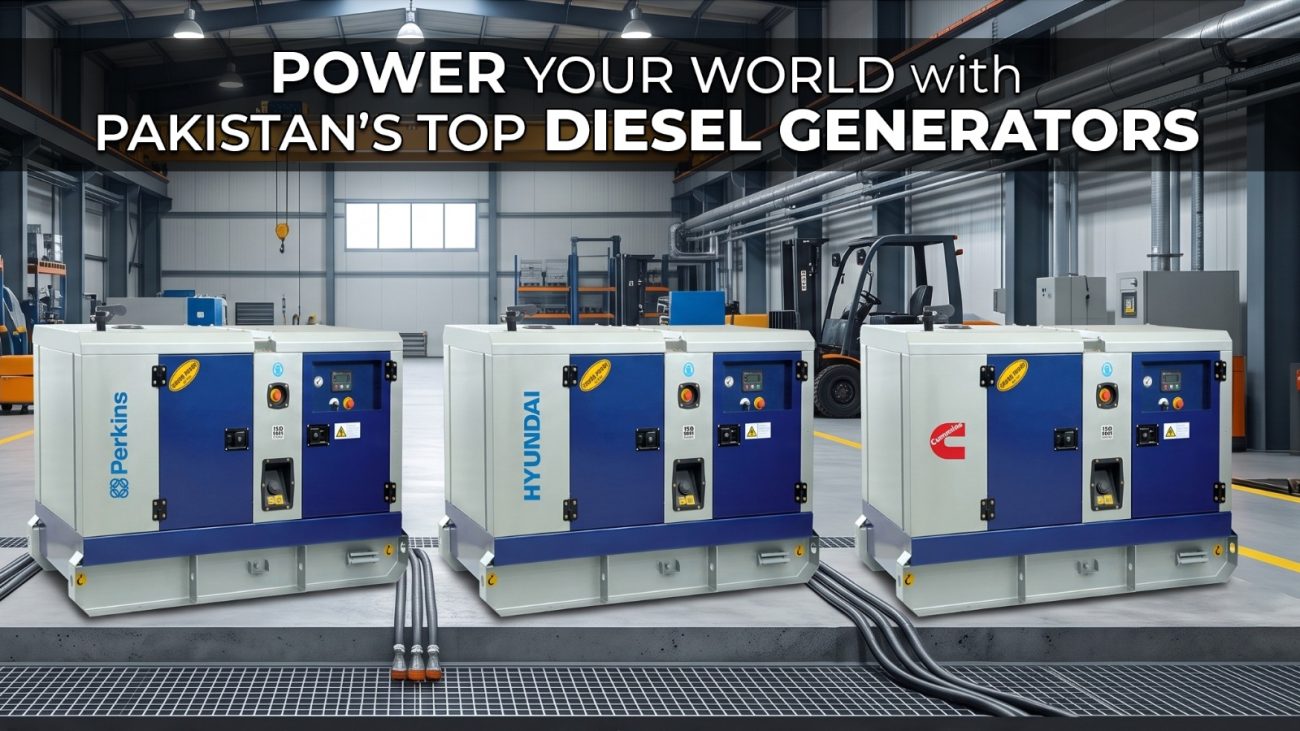
The diesel generator working principle explains what occurs within the machine; specification determines whether that machine suits the application. Engine range is the first constraint. Perkins spans 10 kVA to 1375 kVA, Baudouin 15 kVA to 1250 kVA, Cummins 22 kVA to 550 kVA, and the Hyundai line covers 10 kVA to 125 kVA, which means a small workshop and a continuous-process mill are not selecting from the same catalogue.
Brand selection should follow operational priority rather than reputation. A Perkins generator commends itself to operators who value the widest spare-parts network, and our Perkins line-up reflects that breadth. A Baudouin generator frequently prevails on capital cost at mid-range loads. A Hyundai generator, also distributed through Hyundai Power Pakistan, suits light commercial and residential standby duty where footprint and acquisition cost dominate.
Sizing is the next discipline. Operators should total the running load, apply approximately twenty percent headroom, then test the result against the derating penalty imposed by local ambient conditions. Undersizing invites wet stacking and its attendant carbon fouling, while oversizing consumes fuel inefficiently at chronic part load. Our walkthrough on capacity calculation sets out the arithmetic, and the broader range we supply can then be matched against it.
Price tracks capacity, engine origin and alternator specification far more closely than it tracks the badge on the canopy. Buyers investigating a 50 kVA generator price in Pakistan, or indeed a Hyundai diesel generator price in Pakistan, are in substance comparing four variables: engine tier, alternator make, canopy and control module, and the warranty standing behind the assembly. A diesel generator quoted materially below the prevailing band for its capacity has almost always economised on one of those four, most commonly the alternator or the control module, and the saving is recovered by the seller within the first two years of ownership.
Supplier judgement should ultimately outweigh sticker comparison. The generator companies in Pakistan worth shortlisting hold genuine dealership, carry parts in local stock and answer the telephone at two in the morning. Enpower operates as an authorised Perkins parts dealer in Pakistan from Gurumangat Road in Gulberg, which distinguishes procuring generators in Lahore from acquiring an unsupported container against a marketplace listing. The best generator in Pakistan, on any honest assessment, is the one still running in year eight.
By the Enpower Engineering team — authorised Perkins, Cummins, Baudouin and Hyundai power specialists serving industrial clients across Pakistan.