

Blog
Baudouin Generator Sizing for Industrial Use in Pakistan

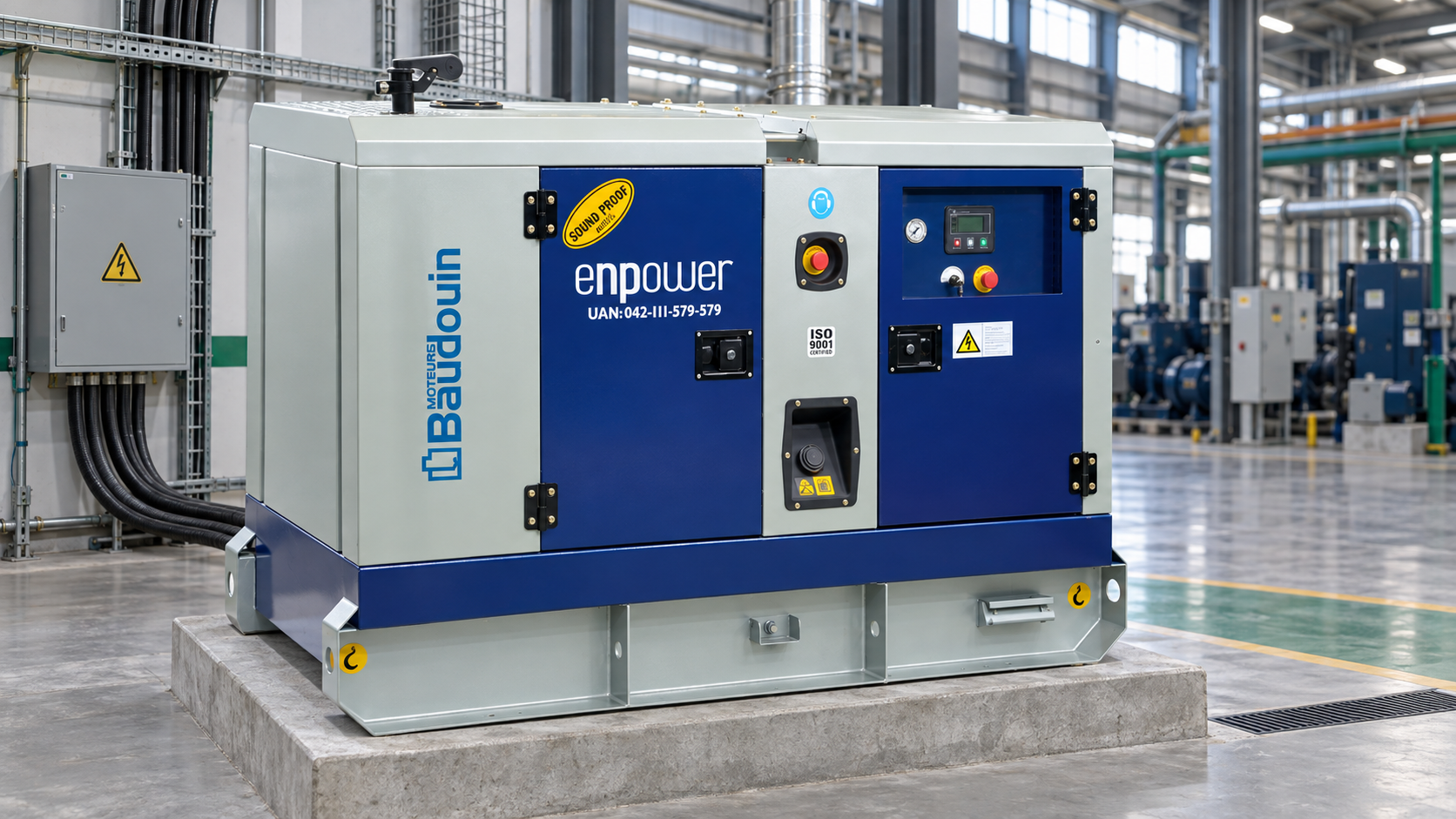
Why Duty Ratings Decide the Specification
Procurement teams across Pakistan’s industrial base still specify a generating set by kVA alone, and that single omission accounts for a large share of premature engine wear and mid-contract capacity shortfalls. A rating is not a figure stamped on a nameplate; it is a statement about how many hours a year the set may run, what average load it may carry, and how much overload it may absorb. Two machines of identical apparent output can be built and warranted for entirely different duty profiles.
For plants on Pakistan’s grid, where scheduled load management and unscheduled outages are both routine, the distinction matters more than it does where utility supply is stable. Enpower supplies four engine platforms across its diesel generator range because no single duty class serves every site.
The Four ISO 8528 Duty Ratings
ISO 8528 is the international standard governing reciprocating engine driven generating sets, and it defines four operating ratings. First, Emergency Standby Power is the output available only for the duration of a utility failure, conventionally capped near 200 hours a year at an average load below 70 per cent, with no overload capability at all. A set sold on those terms and then run daily is being operated outside its warranty.
Second, Prime Power permits unlimited annual hours at a variable load, typically averaging up to 70 per cent, with a 10 per cent overload for one hour in twelve. Third, Continuous Operating Power allows unlimited hours at a constant load up to 100 per cent of the rating, with no overload permitted, and suits flat-demand base-load installations.
Fourth, Limited-Time Running Power allows full output for a restricted annual allowance, commonly around 500 hours, and fits peak-shaving duty. The published technical literature on generator sizing and rating sets out the same standby, prime and continuous distinctions. The class, not the headline output, determines warranty terms, service intervals and economic life.
Load Factor Governs Baudouin Generator Sizing
Load factor is average load divided by rated output across an operating period, and it is the variable that connects an abstract rating to a real plant. Baudouin generator sizing therefore starts with a demand study rather than a catalogue, because one engine can be correctly sold at three different outputs depending on the class applied. Underloading below roughly 30 per cent produces incomplete combustion and carbon accumulation; overloading compresses overhaul intervals.
First, establish the connected load and then the genuine coincident demand, which in most factories is materially lower than the sum of every nameplate on site. Metered consumption across a full production cycle beats any spreadsheet estimate, and it is the step most often skipped.
Second, quantify the largest motor starting requirement separately. Direct-on-line starting of a large compressor or loom motor draws several times its running current, and a set sized only for steady-state demand will hold voltage poorly through that transient.
Third, apply the duty class to the result. A plant drawing 400 kW steadily for twelve hours a day is a prime power rating application and must be specified as one; treating it as standby duty produces a nameplate that looks adequate and a machine abused from commissioning day.
Matching the Baudouin kVA Range to Duty Class
The Baudouin diesel generator range spans roughly 20 kVA to 1375 kVA, covering everything from a single production line to a full plant utility supply. Reading that range through the duty framework, rather than through output alone, turns a long model list into a short shortlist.
At the entry point, the Baudouin Engine 30 KVA class suits workshops, telecom sites, clinics and single-line operations with a modest, predictable profile. Specified to prime duty rather than standby, it carries a working day without complaint.
The 50 kVA class is the usual step up for light engineering units, cold stores and mid-sized commercial premises that have outgrown a small set but carry no heavy motor starting loads.
The 65 kVA class addresses sites with meaningful transient demand, such as small packaging plants and multi-tenant commercial buildings, where headroom for motor starting governs the choice rather than average consumption.
The 100 KVA class marks the practical threshold of the industrial diesel generator tier, serving factories, processing units and larger institutional loads. Above it the range continues to 1375 kVA, where sets are specified to prime or continuous duty and engineered as permanent plant infrastructure.
Sector Fit Across Pakistan’s Industrial Base
Textile is the clearest case, because spinning and weaving floors combine high motor counts with a load profile that stays close to flat through the shift. Textile mill power backup accordingly belongs in the prime or continuous classes, sized with explicit allowance for loom and compressor starting rather than for average draw.
Cement is a different problem. A cement plant generator protects kilns, mills and conveyors, where an unplanned stop costs far more than the lost production hours, so the continuous power rating and generous transient headroom dominate the specification and the sets sit high in the range.
Steel re-rolling and induction melting present the harshest electrical environment of the four. A steel mill generator faces severe repetitive load steps and significant harmonic content, which makes alternator selection and derating as important as the engine rating and rules out standby-rated equipment.
General manufacturing sits at the more forgiving end. A generator for manufacturing plant duty in a food-processing, packaging or assembly operation can usually be specified to prime duty in the 50 to 250 kVA band, provided the survey has captured the compressed-air and refrigeration loads running quietly in the background.
Specification Discipline at the Procurement Stage
A defensible tender document states the duty class alongside the kVA figure, records expected annual running hours, names the assumed average load, and specifies the largest single motor to be started. Those four lines remove most of the ambiguity that later becomes a warranty argument.
Enpower’s engineering team conducts site load studies, specifies to the correct duty class and supports the installed base through installation, commissioning and annual maintenance contracts; the services division is the right first contact for a sizing review or a written quotation. Because requirements vary so widely by sector and site, capacity, configuration and commercial terms are confirmed on a project basis.
Frequently Asked Questions
What is the difference between prime and standby power ratings?
A standby power rating covers emergency use only, typically near 200 hours a year at an average load below 70 per cent, with no overload allowance. A prime rating permits unlimited annual hours at variable load plus a 10 per cent overload, which is what most Pakistani factories actually need. What load factor should an industrial generator be sized for?
A well-specified installation targets an average load of roughly 50 to 75 per cent of the selected rating. Below about 30 per cent the engine runs too cool and accumulates unburnt fuel and carbon; sustained operation above the class ceiling shortens overhaul intervals. Which kVA class suits a textile mill?
Most weaving and spinning units fall in the mid to upper part of the range and should be specified to prime or continuous duty. The governing figure is rarely average consumption; it is the transient headroom needed to start loom, compressor and humidification motors without a voltage dip. Does ISO 8528 apply to every generating set sold in Pakistan?
It is the international reference standard for reciprocating engine driven generating sets, and reputable manufacturers rate their products against it. Buyers should insist that any quoted output states its rating class explicitly, because an output figure without a duty class is commercially meaningless. Can one set cover both standby and prime duty?
A single machine is rated for one class, though the same engine platform is often offered at different outputs depending on the class applied. Where a site has both an emergency requirement and a daily running requirement, specify to the more demanding of the two.
By the Enpower Engineering team — authorised distributor of Perkins, Cummins, Baudouin and Hyundai diesel generating sets across Pakistan.