

Choosing the Right Restaurant Generator for Commercial Kitchens

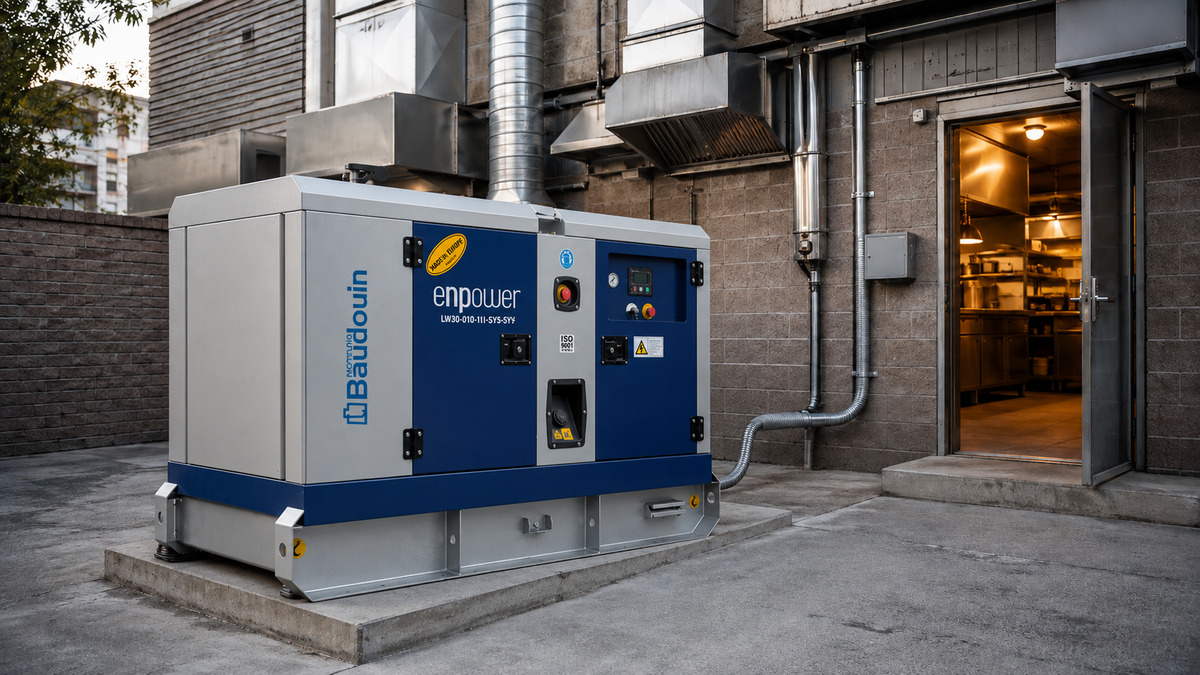
Why a Restaurant Generator Is a Different Purchase
Restaurants and food-service operators in Pakistan buy backup power under conditions most commercial buyers never face. A kitchen that loses power mid-service loses the covers on the pass, the stock in the walk-in and the confidence of every seated guest. A restaurant generator is specified around continuity of service, not headline capacity, because it has to hold refrigeration, extraction and lighting without interruption.
Why a Restaurant Generator Is a Different Purchase
Restaurants and food-service operators in Pakistan buy backup power under conditions most commercial buyers never face. A kitchen that loses power mid-service loses the covers on the pass, the stock in the walk-in and the confidence of every seated guest. A restaurant generator is specified around continuity of service, not headline capacity, because it has to hold refrigeration, extraction and lighting without interruption.
Spoiled inventory, idle kitchen wages and a damaged delivery-platform rating all land within hours of a failed changeover. Reliable backup power for restaurants is best treated as an operational control, not a capital line to be trimmed — the framing behind the full diesel generator range Enpower supplies to commercial sites.
Mapping the Commercial Kitchen Load
Sizing begins with an honest kitchen load profile, not a nameplate tally. First, continuous loads: walk-in chillers, under-counter refrigeration, extraction hoods and the point-of-sale network. Second, intermittent loads: combi ovens, induction ranges and dishwashers. Third, surge behaviour, because a commercial kitchen generator is rarely defeated by steady-state demand — it is defeated by simultaneous motor starts.
Refrigeration starting load is the specific figure that trips undersized sets. A compressor can draw several times its running current briefly, so when three or four restart together after an outage the instantaneous demand far exceeds the sum of the plate figures. A properly specified diesel generator for restaurants carries enough alternator headroom to absorb that inrush, a calculation set out in Enpower’s guide to calculating required capacity.
Deciding the correct generator size for a restaurant also means deciding what does not need to run. Many operators power the kitchen, refrigeration, extraction and payment systems while leaving part of the dining-room air conditioning on a manual restart — moving the site to a smaller frame with no loss of trading capability.
Standby, Prime and the Reality of Daily Outages
Duty rating is where restaurant specifications most often go wrong. A standby generator is designed for a limited number of hours per year, on the assumption that mains supply is normal and the set is an emergency reserve. That holds in markets with stable grids, but not in Pakistan, where a restaurant on a heavily shed feeder may run its set for several hours daily through summer.
Where daily running hours are genuinely high, the set should be assessed against a prime power rating instead, which permits unlimited hours at a variable load. First, log actual outage hours across a full month rather than estimate them. Second, compare that log against the manufacturer’s duty definitions for the frame. Third, if load shedding pushes running hours past the standby rating, the frame should be uprated rather than overrun, since sustained overrun shortens engine life. Getting this right is what makes backup power for restaurants dependable in its third year, not just its first.
Fuel Planning and Realistic Runtime
Fuel consumption and runtime deserve the same attention as capacity, because a restaurant cannot pause service to arrange a delivery. A set running at roughly half load through a long evening consumes a predictable quantity of diesel, taken from the manufacturer’s consumption curve, and that figure should size the day tank and bulk storage. Plan against the worst realistic week of the year, with a margin for delivery lead time.
Fuel quality matters as much as quantity, since storage is often squeezed into a yard shared with waste areas. Contaminated diesel blocks filters and causes the mid-service shutdown the installation exists to prevent, so a sealed tank, a water separator and a documented turnover routine are cheap insurance, as covered in Enpower’s notes on safe on-site fuel storage.
Light loading deserves a warning too. A commercial kitchen generator that spends long periods at a small fraction of its rating will glaze its bores and accumulate unburnt fuel in the exhaust — wet stacking. Oversizing to feel safe creates a maintenance liability of its own.
Noise Levels and Placement on a Restaurant Site
Few sites constrain a set as tightly as a restaurant does. Generator noise levels that pass without comment on an industrial plot become a commercial problem when the enclosure sits ten metres from an outdoor terrace or a neighbour’s windows. Acoustic canopies, residential-grade silencers and anti-vibration mounting protect the dining experience the business sells, and Enpower’s guidance on reducing noise and vibration applies directly.
Generator placement has to satisfy three demands at once. First, the set needs genuine ventilation rather than a sealed cupboard behind the kitchen. Second, exhaust must terminate where fumes cannot be drawn back into the extraction system or dining area. Third, the position must allow fuel delivery and servicing without staff crossing a live kitchen, as set out in the installation guidance for commercial premises.
Changeover should be automatic. An automatic transfer switch senses the loss of mains, starts the set and transfers the load within seconds, removing the delay and backfeed risk of a manual arrangement.
Maintenance Around Service Windows
A generator maintenance schedule in food service has to be built around trading hours, not the convenience of the service engineer. Test runs and filter changes belong in the morning gap or on a closed day, booked as fixed appointments. First, a monthly on-load test confirms the set will actually accept the kitchen’s load, not merely start. Second, filters, belts and batteries should be replaced on hours-run intervals, since a flat battery is the commonest reason a standby generator fails to start when needed.
Third, the arrangement should be revalidated whenever the kitchen changes, since a new combi oven or an extended terrace alters the original load. Operators running several branches benefit from one agreement across sites, which is how Enpower structures its after-sales and maintenance cover.
Specifying and Procuring with Confidence
Procurement becomes straightforward once the technical work is done. An operator should bring a measured load schedule, honest running hours, the site’s acoustic and access constraints and a list of what must stay live during an outage; a supplier can then propose a frame, alternator and control specification against a defined scope. Because configuration varies by site, commercial terms for backup power for restaurants are issued per project — operators can request a written quotation.
Restaurant groups planning several openings should specify once and repeat. Standardising on one engine platform simplifies spares, training and service coverage, and makes each subsequent restaurant generator a repeat of a proven configuration, which is why multi-site operators settle on a single established engine platform.
Frequently Asked Questions
What generator size for a restaurant is usually required?
It depends on the kitchen’s measured electrical demand, not the floor area. A small cafe sits far below a full-service kitchen running walk-ins, extraction and combi ovens. A commercial kitchen generator should be sized from a measured load schedule that includes motor starting current.
Should a restaurant choose a standby or prime rated set?
A standby generator suits sites where outages are occasional and short. Where load shedding runs the set for several hours daily through summer, a prime rated frame is the safer specification, designed for unlimited annual hours.
How can generator noise be kept away from the dining area?
An acoustic enclosure, a residential-grade silencer, anti-vibration mounts and a carefully routed exhaust do most of the work. Positioning matters just as much, since a diesel generator for restaurants placed away from terraces and windows draws far fewer complaints.
Can one set run the kitchen and the dining-room air conditioning?
It can, but many operators exclude part of the dining air conditioning from the essential-load schedule. Powering kitchen, refrigeration, extraction and payment systems first keeps the frame smaller and the fuel bill lower.
How often should a restaurant generator be serviced?
A restaurant generator should follow the manufacturer’s hours-run intervals, with a monthly on-load test between services. Batteries should be checked at every visit, since they are the most common cause of a failed start.
By the Enpower team — diesel generator sales, installation and after-sales support for commercial operators across Pakistan.