

Why a Diesel Generator Rarely Works at Its Rated Conditions

Why a Diesel Generator Rarely Works at Its Rated Conditions
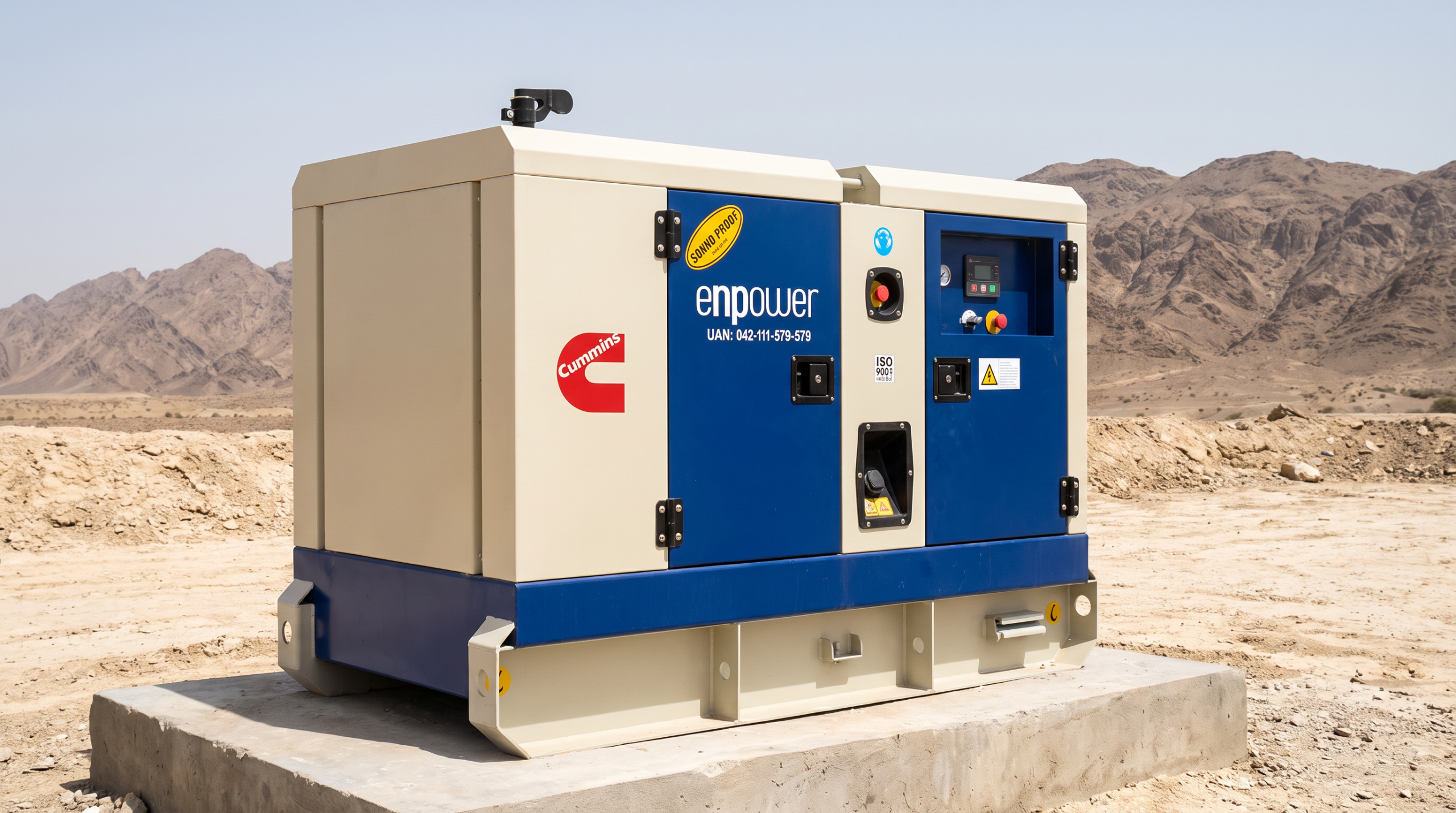
The output on a nameplate is a test-cell figure, measured under fixed reference conditions of moderate air temperature, near sea-level pressure and fairly dry air, and almost no installation in Pakistan operates under those conditions for long. A diesel generator commissioned in a Multan plant room in April may meet its rating comfortably, then struggle through a June afternoon when intake air is ten degrees hotter and the site load is at its seasonal peak. That shortfall is not a fault but derating, the reduction in usable output that engine manufacturers publish for conditions harsher than the reference.
A set sized to nameplate output arrives already short of capacity for the hottest weeks of the year, and the shortfall appears as voltage dips on motor starting, high coolant temperature alarms and shutdowns at the very hour the grid has failed. This pattern recurs across Punjab and Sindh every summer, as Enpower’s service teams see first-hand. The load figure these corrections apply to comes from the generator sizing calculation covered separately.
The Reference Conditions Behind Every Rating
Engine output is standardized under ISO 3046-1, which sets reference conditions of 100 kPa barometric pressure, 25 °C air temperature and 30 per cent relative humidity. ISO 8528-1 rates complete generating sets on the same basis and adds the duty classes of emergency standby, prime, limited-time running and continuous power, and the Wikipedia overview of generating set ratings shows how those classes correspond to ISO 8528. No catalogue figure carries over automatically to a real site.
A diesel engine can burn fuel only in proportion to the oxygen it draws into each cylinder, and air density falls as air gets hotter and as pressure drops with altitude. Less oxygen per stroke means output must be capped to avoid black smoke, high exhaust temperature and turbocharger overspeed. Industrial engines typically hold full output up to a stated threshold before their published curve falls.
Heat Is the Larger Correction on Pakistan’s Plains
For most installations in Punjab and Sindh, generator derating for temperature is the correction that matters. Summer afternoons in Lahore, Multan and Faisalabad regularly reach the mid-forties, and Jacobabad and Sibi record readings around 50 °C in June. Air entering a genset inside an enclosed plant room or a sun-loaded canopy is often hotter still, because the machine’s own radiator and exhaust heat the space around it. The figure that belongs in a specification is therefore the worst credible intake temperature at the machine, not the city’s average maximum.
Heat attacks capacity twice. The engine loses air density and must reduce output to stay within its smoke and exhaust temperature limits, while the radiator loses margin because it rejects heat in proportion to the gap between coolant and air temperature. A radiator selected for a 40 °C design ambient may cope through a mild summer and then overheat at full load on a 48 °C day in Sukkur, so buyers should ask for the radiator’s design ambient in writing alongside the engine’s derating figures.
Altitude Derating for Quetta and the North
Altitude matters little in Karachi or Lahore, but it becomes a primary concern for projects in Balochistan and Gilgit-Baltistan. Quetta lies at about 1,680 metres, Gilgit at roughly 1,500 metres and Skardu at around 2,230 metres above sea level, where atmospheric pressure is well below the 100 kPa reference. Turbocharged engines hold their rating further than naturally aspirated ones, but each model has its own threshold beyond which output falls. Rules of thumb, often quoted as a few per cent of output per 300 metres above a threshold, are no substitute for the published curve of the engine actually offered. Thinner air also carries less heat through the radiator, so a high-altitude site in summer may face both corrections at once.
Engine and Alternator Limits Are Separate
Generator derating is often treated as an engine-only issue, but a generating set is two machines on one base frame, each with its own rating basis. Alternators are conventionally rated under IEC 60034-1 for cooling air up to 40 °C and altitude up to 1,000 metres; beyond either limit the windings run hotter for the same current, and a separate alternator correction applies. The two corrections are not added together. The stricter one sets the usable output of the complete set. The alternator limit tends to govern on sites with heavy motor starting or non-linear loads such as variable-speed drives and UPS rectifiers.
Applying the Correction at Specification Stage
First, establish the site load in kW and the power factor, convert to kVA, and add headroom for motor starting and expansion; a plant needing 400 kW at a 0.8 power factor requires 500 kVA before headroom or site correction.
Second, define the design conditions in writing, taken from the site and room design rather than a regional average: the highest credible intake air temperature at the machine, the site altitude and, on coastal sites, the humidity.
Third, read the manufacturer’s derating curve for each candidate set, for engine and alternator, and take the stricter result. If, purely for illustration, a curve showed a 10 per cent reduction at the stated conditions, a 500 kVA requirement would call for a set rated at roughly 556 kVA under reference conditions, which usually means the next frame size up. The real figure always comes from the specific data sheets.
Fourth, confirm the result sits within the correct duty class: a set expected to run daily through load-shedding must be rated for prime duty, with the correction applied to the prime figure. Oversizing for conditions that last only a few weeks a year carries its own cost, leaving a set lightly loaded and prone to incomplete combustion. Sound diesel generator derating practice balances the two, and the closely spaced frame sizes across the generating sets Enpower supplies make that balance practical.
Writing Site Conditions Into the Enquiry
Most of these problems are prevented at the enquiry stage. An enquiry for a diesel generator should state the design intake temperature, site altitude, humidity where relevant, duty class and expected annual running hours, and should ask each supplier to quote the derated site output for engine and alternator together with the radiator’s design ambient temperature. A quotation that states only a nameplate kVA should be returned for clarification.
Installation then decides whether the corrected rating survives, since poor ventilation and recirculated radiator air raise the temperature the engine breathes; Enpower’s installation guidance covers those points. A specification that gets the generator derating right can still be undone by a poor plant room.
Enpower supplies Perkins, Cummins, Baudouin and Hyundai sets as an authorised distributor. For a written specification review or a site-specific diesel generator derating assessment, procurement teams can contact Enpower, which confirms ratings, configuration and commercial terms on a project basis.
Frequently Asked Questions
What does derating mean for a diesel generator?
Derating is the reduction in usable output that applies when a set runs in conditions harsher than its rating basis, such as higher temperature, altitude or humidity. The site output, not the nameplate figure, is the number to size against.
At what temperature does a generator start losing output?
It depends on the engine model. Many industrial engines hold full output to a stated threshold above the 25 °C reference before their curve falls, so the figure must be read from the data sheet of the set being offered.
Do generators in Quetta and Skardu need a larger rating?
Often, yes. At about 1,680 meters in Quetta and around 2,230 meters in Skardu, lower air pressure reduces engine output and alternator cooling. The site altitude should be stated in every enquiry so suppliers can apply their own curves.
What should a generator quotation state about site conditions?
It should give the derated output at the site’s design temperature and altitude, the duty class, and the radiator’s design ambient temperature. An offer showing only a nameplate kVA cannot be compared fairly with one corrected for the site.
By the Enpower Engineering team — authorised distributor of Perkins, Cummins, Baudouin and Hyundai diesel generating sets across Pakistan.